
VAREQA
VA
Value
RE
Role Evaluation
QA
Quality Architecture
Pay Architecture · Job Evaluation · Compliance Infrastructure

Vareqa is the
pay architecture platform.

Grade every role. Build every band. Defend every decision, to your people, your auditors, and your regulators. Vareqa is how your organisation structures, explains, and stands behind the way it pays.
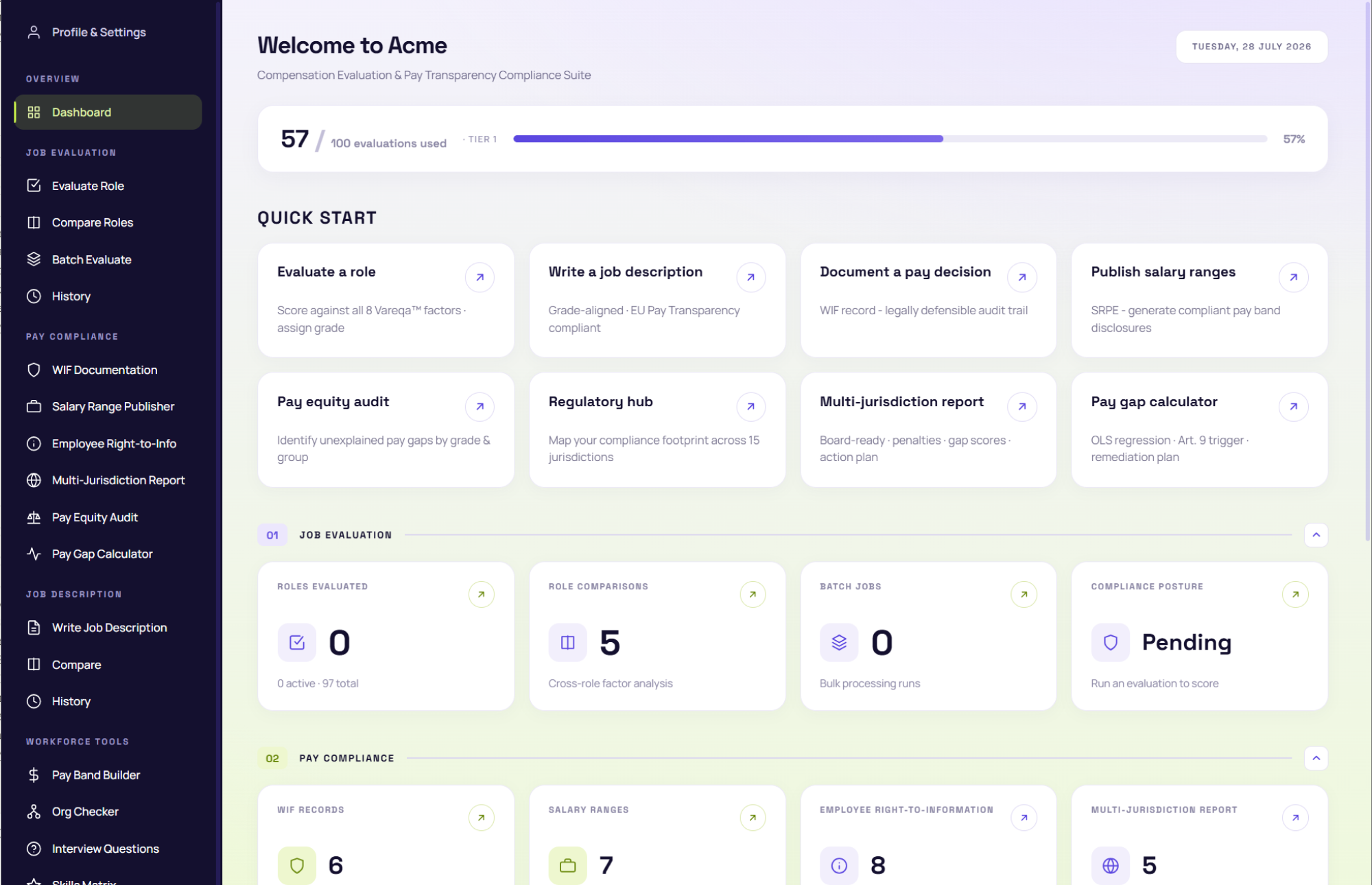
Pay transparency is now legislated across 15 jurisdictions. The EU Directive takes effect 7 June 2026. If you need to show your work, we built Vareqa for that.
Book a Pay Architecture Review See how it works
8-factor transparent methodology
1,000 points, 20 grade levels
15 jurisdictions, 37 obligations mapped
14 language outputs
The Roleplay Evaluation Framework™ (REF™)

The foundation of every
pay architecture: a transparent framework.

Every role has a value. The question is whether you can explain how you arrived at it. REF™ is eight compensable factors with published point values, 1,000 maximum points, and twenty grade levels from Foundation to Group Board. It is rigorous enough to withstand a regulator's scrutiny, and simple enough that the employee in question can follow it.

F-01
180 pts
Organisational Impact
The scope and consequence of the role's decisions. From task-level work to decisions that shape entire markets.
F-02
160 pts
Knowledge Depth
The technical and professional knowledge the role demands. From foundational working knowledge to expertise that defines industry practice.
F-03
150 pts
Problem Complexity
The nature of problems this role encounters. From routine structured tasks to pioneering challenges where no established solution exists.
F-04
140 pts
Decision Autonomy
The degree of independent judgement this role exercises. Authority and accountability are independent sources of value, not sub-dimensions of knowledge.
F-05
130 pts
People Leadership
Scope of people accountability. From individual contributor through to enterprise-wide leadership spanning thousands of employees across geographies.
F-06
120 pts
Influence & Communication
The complexity of communication this role requires. From sharing information with colleagues to shaping external stakeholder behaviour and market perception.
F-07 Key departure
100 pts
Innovation Requirement
Scored independently at 10%. Not a sub-dimension of problem solving. In an economy where AI handles routine cognitive work, the capacity to identify what is worth building is a primary value driver.
F-08
20 pts
Working Environment
Physical and risk conditions, weighted at 2%. Present because the framework must cover all role types, not just desk-based ones.
Level breakdowns. Market equivalency guide. Interactive evaluator.
The full REF™ methodology is published. Factor definitions, level descriptors, weightings, the 20-grade structure, and an indicative market equivalency guide for organisations migrating from a legacy point-factor framework. Everything you need to understand it, evaluate it, and explain it to anyone who asks.
Read the full methodology
How it works

From role list to a defensible
pay architecture in
under two weeks.

A 500-employee organisation can go from no formal grade structure to a fully documented pay architecture in under two weeks using Vareqa. The same outcome through a traditional consulting engagement takes eight to twelve weeks and costs several multiples more.

Most organisations already have the raw material: role descriptions, internal job titles, existing salaries, some sense of where people sit relative to each other. What they lack is a consistent framework that turns that raw material into a defensible structure. Vareqa provides that framework, with an AI-assisted workflow that makes the evaluation practical at the scale real organisations operate at.

The output is a complete job architecture with defensible grades from R-01 to R-20, documented factor-level rationale for every role, pay bands linked to those grades, and compliance outputs ready to share with employees, auditors, or regulators. The methodology is published in full. If someone asks how a grade was reached, you can show them.

Step 1 · Upload your role inventory
HR uploads the organisation's role list. A 500-employee organisation typically has 80 to 250 unique roles. The platform ingests the data and queues each role for evaluation under the REF™ methodology. Day 1.
Step 2 · Evaluate with AI, validated by you
For each role, Vareqa produces an eight-factor score with documented rationale. Your HR team reviews, overrides where domain knowledge dictates, and approves. Both the AI score and human override are retained as audit trail. Around 2 minutes per role. Days 2 to 6.
Step 3 · Publish bands, reports, and compliance outputs
One action generates pay bands, employee right-to-information reports, multi-jurisdiction compliance outputs, and pay gap analysis. The grade anchors every downstream output. Days 7 to 10.
Around 10 working days, not 10 weeks
A traditional consulting engagement for the same outcome typically takes eight to twelve weeks, delivered by licensed consultants at project fees that scale with organisation size. Vareqa delivers a comparable result in working days, and you can show anyone who asks how it was built.
01
Grade every role with confidence
One published methodology. Eight factors. 1,000 points. Twenty grade levels. If an employee, an auditor, or a regulator wants to see the criteria behind a grade, you show them. There are no workings to hide.
02
Build pay structures that hold up
Grade-linked pay bands, published salary ranges, and documented pay criteria that give your pay philosophy a backbone. When someone questions a pay decision, you have a real answer ready, not a shrug.
03
Answer every question, every time
Right-to-information reports generated in minutes, in the language your employee works in. The output traces back to the grade, the grade traces back to the factor scores, and the factor scores trace back to the role description. Nothing is ever a black box.
Why it holds up

Four layers of defensibility.

A pay architecture is only useful if it holds up when someone questions it. Vareqa is designed around four layers that reinforce one another, so the same methodology answers the employee asking about their grade, the General Counsel reviewing for litigation risk, and the regulator examining how you evaluate work.

LAYER 01
Regulatory coverage

The architecture maps to the law, not the other way around.

Every pay transparency regime places specific obligations on employers. Vareqa maps to them directly: Article 4 of the EU Pay Transparency Directive is satisfied by the REF™ methodology. Article 5 by the Pay Band Builder. Article 7 by the right-to-information report. Article 9 by the Pay Gap Calculator. Article 10 by the Joint Pay Assessment workflow.

The same architecture extends to GCC nationalisation obligations, US state disclosure laws, Japan's EEOA, and UK reporting. Fifteen jurisdictions, 37 legal obligations, each mapped to specific platform outputs.

LAYER 02
Data compounding

Every evaluation strengthens the next one.

Every role evaluated in Vareqa produces structured data: role description, REF™ grade, pay band, geography, industry, headcount. Because all of it comes out of the same methodology, the resulting dataset is consistent in a way that self-reported salary surveys can never be.

As the customer base grows, this supports a benchmark layer that sits on top of the platform: an anonymised view of how comparable roles grade and pay across Vareqa customers. In development for a future release, subject to GDPR and competition law review.

LAYER 03
External validation

The methodology stands up to independent review.

No pay architecture should rest only on the vendor's word for it. To make REF™ independently reviewable, three forms of external validation are in development:

External legal opinion from an EU employment law firm on the methodology's alignment with the EU Directive's transparency and gender-neutrality requirements.
Third-party certification of the methodology against a recognised pay equity standard.
Published methodology paper, academically co-authored, placing REF™ in the open literature on point-factor evaluation.
LAYER 04
System of record

A pay architecture is not a one-off project.

You grade the organisation once, but the obligations that follow are continuous. Ranges get published on every new job advert, employee information requests arrive with 60-day deadlines, annual pay gap analyses come around every year, and new roles need grading as the organisation grows. Treating compliance as a project rather than an operating state is why most organisations end up scrambling.

Vareqa sits underneath this as the system of record: where your grades live, where bands get updated, where responses are generated, and where the full version history is preserved. Any report your organisation has ever issued through Vareqa is traceable back to the methodology, and to the specific evaluation, that produced it.

Worked example: EU Pay Transparency Directive

How the architecture maps to the law.

The EU Directive is the most explicit example of regulatory mapping, because each Article defines a concrete employer obligation. The same approach applies to every jurisdiction Vareqa supports.

Article
Employer obligation
Vareqa output
Art. 4
Gender-neutral job evaluation methodology with criteria covering skills, effort, responsibility, and working conditions.
REF™ methodology with eight factors mapped directly to Article 4(4). Full weighting and level descriptor documentation.
Art. 5
Salary range disclosure to applicants before interview. Pay history questions prohibited. Gender-neutral job titles and postings.
Pay Band Builder, Salary Range Publisher, and the Job Description Writer with bias-detection. Versioned audit history.
Art. 6
Criteria for pay setting and pay progression made easily accessible to workers. Criteria must be objective and gender-neutral.
WIF Documentation module publishes criteria in employee-accessible form. Pay Band Builder supplies the pay-level logic.
Art. 7
Worker right to written information on individual pay and average pay by sex for comparable-work categories, within 60 days.
Employee Right-to-Information Report in 14 languages, with factor-level grade rationale and automatic 60-day deadline tracking.
Art. 9
Seven mandatory pay gap indicators reported to Member State monitoring body. Annual for 250+, triennial for 100-249.
Pay Equity Audit with OLS regression. All seven Article 9(1) indicators computed from one data upload, with auto-flagged Art. 10 trigger.
Art. 10
Joint pay assessment triggered by unjustified 5% gap in any worker category, unremedied within six months.
Joint Pay Assessment workflow with Within-Band Justification Report and remediation tracking. In development.
Art. 18
Where Articles 5 to 10 are not met, the burden of proof in a pay discrimination proceeding shifts to the employer.
Full audit trail. Every grade, override, policy version, and Article 7 response preserved as defensive evidence.
Article-by-Article compliance matrix
Every Article of the Directive walked through, with Vareqa fulfilment, residual employer work, and explicit scoping of what sits outside the platform. Built for General Counsel review.
Open the full matrix
The Platform

Sixteen modules.
One connected system.

Every module in Vareqa shares a single data layer. Evaluate a role once and the pay bands, job descriptions, employee reports, and equity analyses are all built from the same foundation. Change a grade and everything updates together. This is what a pay architecture looks like when it is built as a system, not a collection of tools.

Job Evaluation: Core
Role Evaluation Engine
Evaluate any role against all eight factors in a single guided workflow. AI suggests an initial score with supporting rationale for each factor. You review, adjust where your judgement differs, and confirm the final grade. The whole process takes less than ten minutes and produces a complete audit trail.
Core
Job Evaluation: Comparison
Compare Roles
Place up to three roles side by side and see exactly where they differ across every factor. The system generates a plain-language narrative explaining why roles are graded differently, which is precisely the kind of explanation you need when an employee asks about work of equal value.
Compliance
Job Evaluation: History
Evaluation History and Export
Every evaluation is stored with a complete version history. Export your data in JSON, CSV, or PDF. Every grading decision has a timestamped record showing who evaluated it, what the AI suggested, and what the practitioner decided. That is your audit trail.
Core
Pay Compliance: Documentation
WIF Documentation
Documents the legitimate, gender-neutral criteria that explain why two people in the same grade might be paid differently, covering things like performance, experience, and specialist skills. Required under EU Directive Article 6. Vareqa generates the attestation document you need to demonstrate compliance.
EU Required
Pay Compliance: Publishing
Salary Range Publisher
Takes your evaluated grade structure and generates the salary range disclosures your job postings need by jurisdiction. One workflow covers EU member states, the UK, US state requirements, Canada, and Australia. The range comes from your grade structure, not a guess.
EU Required
Pay Compliance: Employee Rights
Employee Right-to-Information
When an employee asks about their grade, their pay, or how they compare to colleagues doing similar work, Vareqa generates a personalised, plain-language response in seconds. Available in all EU languages. Covers everything the Directive requires, in a format a human being can actually read.
EU Required
Pay Compliance: Audit
Pay Equity Audit
Analyses your pay data by grade, gender, and protected characteristic using both mean and median measures. Flags where gaps exist and whether they cross reporting thresholds in each of your operating jurisdictions. Find the issues before your regulators do.
Compliance
Workforce: Job Design
Job Description Writer
Generates grade-aligned job descriptions with the pay range section already built in. Configurable by tone, length, jurisdiction, and language. Salary history ban language is included by default for jurisdictions that require it.
Workforce
Workforce: Pay Architecture
Pay Band Builder
Builds grade-linked pay bands with configurable spread and overlap between adjacent grades. Set your market position, choose your currency, and Vareqa produces the pay ranges your organisation needs, along with the formatted disclosures for publication.
Workforce
Workforce: Structure
Org Structure Checker
Scans your evaluated role population for grade inversions, pay compression, and span-of-control problems. Surfaces the structural issues that tend to drive pay disputes and retention problems, and gives you prioritised recommendations for addressing them.
Workforce
Workforce: Talent
Interview Questions and Skills Matrix
Generates structured interview questions calibrated to the grade and factor profile of the role you are filling. Maps team skills against strategic priorities and identifies development gaps. Hiring decisions grounded in the same framework as your pay decisions.
Workforce
One evaluation, everything connected. Every module in Vareqa draws from the same evaluated grade and role profile. When a grade changes, the pay bands, job descriptions, employee reports, and equity analyses all reflect it. You never have to reconcile conflicting versions or re-enter data across systems.
Employee Rights

When an employee asks,
you need a real
answer ready.

Employees in the EU now have a legal right to know their grade criteria, their pay range, and how their pay compares to colleagues doing comparable work. The Directive gives organisations 60 days to respond. That is a short window when you are starting from scratch.

Vareqa generates the response in minutes. A personalised, plain-language report in the employee's own language, covering everything the Directive requires and anchored to a methodology they can actually examine. Not a standard letter. A real answer.

Answering clearly builds trust and reduces disputes. Answering poorly, or not at all, creates claims, tribunal exposure, and a compliance record you would rather not have. The difference is whether you built the infrastructure to answer properly, or whether you are trying to improvise one under pressure.

60d
Maximum response time under EU Directive Art. 7 when an employee exercises their right to information. Vareqa generates the report in minutes, with automatic deadline tracking.
27
EU member states transposing the Directive by 7 June 2026. Each has its own national nuance. Vareqa's reports are jurisdiction-aware by default.
14
Output languages including English, German, French, Spanish, Italian, Dutch, Polish, Portuguese, Arabic, and Japanese. Every employee gets a response in the language they actually work in.
€0
Cost to the employee to make a request. Employers cannot impose fees or conditions. You need to be ready to answer, every time, for free.
Global by Design

One pay architecture.
Every workforce.

Whether your people are in Frankfurt, Dublin, New York, Dubai, or Tokyo, Vareqa gives you a single defensible architecture that travels with your organisation.

14 platform output languages
Every output, every language
Employee right-to-information reports, grade rationale, job descriptions, and pay range disclosures, all generated in the language your employee actually works in. Fourteen output languages across the platform, covering every major EU employment language plus Arabic and Japanese. Not a translation layer added afterwards. Language is a first-class output setting in every Vareqa module.
ENEnglish DEDeutsch FRFrançais ESEspañol ITItaliano NLNederlands PLPolski PTPortuguês ARالعربية JA日本語 +4more
Works councils
Works council ready
Documentation structured for works council review. Methodology fully publishable. No redactions required. Germany, France, Netherlands, and Belgium all supported out of the box.
Country-level
Country compliance alignment
Outputs aligned to the specific transposition requirements of each EU member state your organisation operates in. Not a generic EU output, a country-specific one.
EU / UK / GCC / US
Data residency options
EU-hosted infrastructure for GDPR compliance. GCC-resident option for Saudi and UAE organisations. Role data, not personal data, means data localisation requirements are typically not triggered.
The single architecture advantage
One pay architecture that works wherever your people are, with the local outputs each jurisdiction requires.

Organisations operating across multiple jurisdictions carry unnecessary legal and operational risk when they maintain different grade structures per country or region. Vareqa provides a single, consistent architecture that works whether your people are in the EU, UK, GCC, US, or Asia Pacific, with jurisdiction-specific outputs where needed.

Germany: works council documentation ready
France: comité social et économique aligned
Netherlands: ondernemingsraad ready
All EU: employee explanation right satisfied
GCC: Emiratisation, Nitaqat and WPS reporting supported
Japan: EEOA-aligned pay gap outputs
How AI Works in Vareqa

AI does the groundwork.
You make the call.

AI in Vareqa is a tool for speed and consistency, not a replacement for professional judgement. Every evaluation is reviewed and confirmed by a qualified practitioner. The AI suggestion and the practitioner decision are both recorded.

How AI works in Vareqa
01
AI reads the role and suggests scores
The AI analyses the role context and proposes a score for each of the eight factors, with a rationale and a confidence rating for each suggestion. You see exactly why it scored what it scored.
02
You review and make the final call
You go through each factor, accept the AI suggestion where you agree, and adjust where your professional judgement differs. The final grade is your decision, not the system's.
03
Everything is on the record
The AI suggestion, your review, any adjustments, and the final grade are all recorded with a timestamp. When a regulator or employee asks how a grade was reached, the complete story is there.
04
The framework is always in control
AI outputs are constrained to the published Vareqa methodology. It cannot introduce new criteria or deviate from the eight-factor structure. Everything it produces can be checked against a published standard.
Where the line is drawn
The AI does not make final grading decisions. It does not approve pay bands or generate employee reports without a practitioner reviewing the output first. Every consequential decision in Vareqa requires a human being to confirm it.
When the AI is not confident about a factor, it says so clearly and flags it for your attention rather than offering a low-confidence score as though it were reliable.
Using AI in Vareqa means your evaluations are faster and more consistent. Your accountability as the practitioner does not change. That is a deliberate design choice, not a limitation.
AI Architecture
Model-agnostic: Structured prompting
Vareqa uses leading large language models for pre-scoring with a structured, auditable system prompt. The methodology is not tied to any single AI provider: the framework logic governs outputs, not the model.
Regulatory coverage

Fifteen jurisdictions.
Thirty-seven obligations. One architecture.

Pay transparency legislation is active or imminent across every major employment jurisdiction. The EU Directive, GCC nationalisation programmes, US state disclosure laws, Japan's EEOA, UK reporting, and Australia's WGEA are all heading in the same direction. One defensible pay architecture handles all of it, with jurisdiction-specific outputs where the law requires them.

EU
EU Pay Transparency Directive
Directive 2023/970/EU · All EU member states · Binding: 7 June 2026
Active · Binding
This applies to any organisation with employees in EU member states, regardless of where the business is headquartered. UK, GCC, and US multinationals with EU operations are all in scope. It is the most comprehensive pay transparency law enacted globally.
Pay ranges in all job postings, before any first interview
Employee right to request pay comparator data in writing
Evaluation criteria must be objective, gender-neutral, and visible to employees
Gender pay gap reporting from 2027 for organisations with 100 or more employees
Joint assessments required where a gap above 5% cannot be justified
Burden of proof sits with the employer in all pay discrimination claims
Vareqa covers: Role evaluation, WIF documentation, salary range publication, employee right-to-information reports, pay equity audit, and pay gap reporting. All modules are designed to satisfy the specific articles of this Directive.
GB
UK Pay Transparency Regulations
Equality Act 2010 amendments · Anticipated 2025 to 2026
Expanding 2025
The UK government has signalled clear intent to extend pay transparency obligations. Mandatory pay range disclosure in job adverts is expected within the current legislative programme, alongside strengthened equal pay audit requirements.
Pay range disclosure required in all job advertisements
Strengthened equal pay audit requirements for larger employers
Ethnicity pay gap reporting expected for 250 and above
Gender pay gap reporting extended to smaller employer bands
Vareqa covers: Salary Range Publisher generates UK-specific pay range disclosures. Pay Equity Audit covers gender and ethnicity gap analysis with UK threshold flags.
US
US Pay Transparency Laws
Colorado, California, New York, Washington, Illinois · Active in multiple states
Active · Multi-state
Five major states covering most of the US private sector workforce have active pay range disclosure requirements. Managing these state-by-state obligations is increasingly difficult without a coherent, evaluated grade structure underpinning the published ranges. Federal legislation is widely anticipated.
Salary range disclosure mandatory in job postings in covered states
Pay scale disclosure to current employees on request in California
Pay data reporting to state agencies in California and Illinois
Federal legislation widely anticipated in the near term
Vareqa covers: Salary Range Publisher generates state-specific disclosures. The evaluated grade structure provides the defensible foundation for any pay scale disclosed to employees or regulators.
CA
Canada Pay Equity Act
Federal Pay Equity Act · In force
Active
Canada's federal Pay Equity Act requires federally regulated employers to proactively identify and correct pay inequity between predominantly female and predominantly male job classes. A documented, evaluated job architecture is the foundation of compliance.
Proactive pay equity obligation, not complaint-driven
Pay Equity Plan required, published and updated regularly
Job class comparisons require documented, objective criteria
Vareqa covers: The evaluation methodology satisfies the requirement for objective, documented job class comparison criteria. Pay Equity Audit produces the structured gap analysis the Act requires.
EU
EU Corporate Sustainability Reporting (CSRD)
Directive 2022/2464/EU · Effective from 2025 to 2028 in stages
Rolling in 2027
The CSRD requires organisations to report on workforce-related social factors including pay equity, gender diversity by seniority level, and fair remuneration practices. A documented, evaluated job architecture is the foundation on which all of those disclosures rest.
Mandatory reporting on pay equity and gender pay gap by seniority tier
Workforce composition by grade level is a required ESRS S1 data point
Fair remuneration disclosures require an underlying grade structure
Applies to listed SMEs from 2026 and all in-scope entities by 2028
Vareqa covers: Evaluation history and pay equity data provide the structured inputs CSRD reporting requires. Multi-Jurisdiction Reporting generates the ESRS S1 workforce composition data point.
GB
Mandatory Equal Pay Audits
Employment Rights Bill · Anticipated UK amendment
Anticipated 2026
The UK Employment Rights Bill is expected to introduce mandatory equal pay audits for employers above a certain threshold. Organisations that cannot demonstrate their pay decisions are anchored to a documented, objective methodology face direct legal exposure the moment an audit is required.
Mandatory audits require a defensible evaluation methodology
Employers without documented grading face automatic adverse inference risk
Applies regardless of whether a pay gap exists, since the process itself must be documented
Vareqa covers: The Vareqa audit trail provides the structured evidence an audit requires. Pay Equity Audit produces findings in a format suitable for regulatory submission.
INTL
AI in Hiring Regulation
EU AI Act · NYC Local Law 144 · Anticipated federal rules
Emerging
The EU AI Act classifies automated systems used in employment decisions as high-risk, triggering transparency, auditability, and human oversight requirements. Any AI-assisted job evaluation that cannot demonstrate a human practitioner in the loop will struggle to meet these standards.
EU AI Act high-risk classification applies to AI-assisted grading systems
Requires documented human oversight: Vareqa's practitioner model satisfies this
Bias audit requirements demand transparent, documented evaluation criteria
Vareqa covers: The practitioner review and override model satisfies human-in-the-loop requirements. Every AI output is documented alongside the practitioner's decision in an immutable audit trail.
INTL
Skills-Based Hiring Legislation
US Executive Order · UK Skills Reform · EU recognition · Global, emerging
Emerging
The shift from degree-based to skills-based hiring is being codified in law across multiple jurisdictions. Job architectures built on credential requirements are becoming legally and commercially untenable. Vareqa's factor-based methodology is inherently skills-oriented, not credential-oriented.
Degree requirements must be demonstrably justified or removed
Skills-based role profiles represent best practice under equality law
Vareqa covers: Role evaluation is competency and skill-anchored, not credential-anchored. The framework naturally produces role profiles suited for skills-based hiring compliance.
SAAE
Saudi Arabia & UAE Data Protection Laws
KSA PDPL: UAE Federal PDPL: In force September 2024
GCC: Active
Both laws are now fully enforceable. The key question for Vareqa clients is whether job architecture data (role titles, descriptions, grades) constitutes personal data under these frameworks. Used as intended, it does not, so no mandatory data localisation is triggered.
Role-level data classified separately from personal employee data
No localisation requirement for job architecture data as used in Vareqa
Employee-linked records require additional consideration
Phase 2 infrastructure includes a GCC-resident data option
Vareqa covers: Job architecture data used in Vareqa does not trigger localisation under KSA PDPL or UAE PDPL as implemented. GCC-resident hosting option available for clients requiring belt-and-braces compliance.
SAAE
Saudisation & Emiratisation Reporting
Nitaqat: Emiratisation quota system: GCC momentum building
GCC: Active
Saudi Arabia's Nitaqat programme and the UAE's Emiratisation targets require organisations to demonstrate localised workforce composition by job category and seniority level. As both frameworks mature, the expectation is that reported job categories align with a structured, documented job architecture, rather than ad hoc titles.
Job category reporting requires structured, consistent role classification
Grade-aligned reporting reduces reclassification risk during HRSD audits
Formal architecture supports Vision 2030 talent localisation objectives
Vareqa covers: The evaluated grade structure provides the consistent job category framework Nitaqat and Emiratisation reporting requires. GCC-resident infrastructure supports regional compliance posture.
INTL
Equality (Race and Disability) Act
Employment Rights Bill: Anticipated 2025, consultation underway
Anticipated 2025
The UK government's Employment Rights Bill and expected Equality Act amendments will extend mandatory pay gap reporting to ethnicity and disability, following the same framework as the 2017 gender pay gap regime. Organisations without documented job architecture will face compounding compliance obligations.
Mandatory ethnicity pay gap reporting for 250 and above employees
Disability pay gap reporting obligations anticipated
Requires robust job architecture for intersectional analysis
Vareqa covers: Pay Equity Audit extends to ethnicity and disability gap analysis. The evaluated grade structure provides the consistent job category framework intersectional reporting demands.
INTL
Right to Explanation: Pay Decisions
EU Directive: UK anticipated: APAC emerging
Emerging Global
The EU Pay Transparency Directive gives every employee in Europe the right to a written explanation of their grade and how it was reached. Australia, Canada, and several APAC jurisdictions are moving toward similar employee rights frameworks. Organisations that cannot produce a clear, documented explanation of why a role is graded where it is, in language an employee can actually understand, will face increasing legal and reputational pressure.
EU employees can request written grade rationale from June 2026
Explanation must reference objective, documented evaluation criteria
Plain-language requirement, so legal boilerplate does not satisfy the Directive
APAC jurisdictions accelerating toward similar employee explanation rights
Vareqa covers: Employee Right-to-Information module generates plain-language grade explanations in in seconds, in all major EU employment languages. Every explanation is anchored to the published Vareqa methodology and legally defensible.
A different architecture

A methodology built to
be shown, not hidden.

Most job evaluation frameworks were designed in a world where opacity was acceptable. Criteria stayed locked away, scores were produced by consultants, and employees never saw the workings. That model was always an expensive way to build a pay architecture. It is no longer even an acceptable one.

Traditional frameworks
Scoring logic is contractually protected. It cannot be shared with employees or regulators.
Evaluations typically require a licensed consultant. Weeks to complete, at significant cost per engagement.
Disclosing the methodology undermines the IP model that justifies the pricing structure.
The output an employee sees is a grade. There is no accompanying rationale or explanation of how it was reached.
The opacity that defines these frameworks conflicts with what EU Directive Article 4 now requires from every employer.
Vareqa
Fully transparent methodology. Factor definitions, point values, and grade thresholds are published and shareable.
Self-serve. First evaluation in under 10 minutes. No consultant required. No engagement fee.
Designed to be shared. Transparency was a requirement, not an afterthought, from day one of the methodology's design.
Every evaluation produces a plain-language rationale in the employee's language. Readable by anyone who asks.
Compliant with EU Directive Article 4 by design. Includes a market equivalency guide for migration from legacy frameworks.
Pricing

Three tiers.
One clear decision.

Vareqa is priced per organisation, with an annual subscription only. Every tier gives your entire HR team unlimited user access. Choose the tier that matches the scale of your workforce and the depth of pay architecture you are building.

Essentials
Build your foundation
For organisations of 100 to 500 employees putting a defensible pay architecture in place for the first time. Evaluate roles, build pay bands, meet core employee obligations.
Annual evaluation allowance
250
roles per year
Role Evaluation Engine
Compare Roles
Pay Band Builder
Job Description Writer
WIF Documentation
Salary Range Publisher
Evaluation History and Export
Unlimited users
Request Access
Enterprise
Group-wide scale
For employers of 2,000 or more, and groups evaluating full workforce populations. Adds the capacity, data residency, and integration options for systematic grading across entities.
Annual evaluation allowance
2,000
roles per year
Everything in Professional
Multi-jurisdiction compliance reporting
API access for HRIS integration
Dedicated implementation support
SLA and EU / GCC data residency
Extended batch evaluation
Unlimited users
Request Access

Organisation above 2,000 evaluations per year, or a group with multiple operating entities? Talk to us about an arrangement that fits your scale.

All tiers are annual subscriptions. A 10% loyalty saving applies from Year 2. Every tier includes unlimited users; single and batch evaluations count toward your annual total.

HR Consultants and Advisory Firms
Using Vareqa in client delivery?

Partner arrangements are available under specific terms, including attribution requirements, agreed client delivery terms, and revenue share options. This is not a self-serve purchase.

Partner Inquiry
Get Started

Book a Pay Architecture
Review.

A 30-minute conversation. Tell us about your organisation and where you are today. We will walk you through where Vareqa fits, where your current exposure sits against the regulations that apply to you, and what it would take to put a defensible architecture in place on your specific timeline.

Live preview
Vareqa™ Role Evaluation
Select a role to see how Vareqa grades it.
Chief Accountant
Financial Services
Marketing Director
General
Operations Manager
General
Administrative Assistant
General
Chief Strategy Officer
General
-
Vareqa™ Points
-
Technical competencies
Behavioural competencies
This is one of 14 modules in the Vareqa Workbench.