
Select language
The Framework
Eight compensable factors, a 1,000-point scale and 20 grades. Every score is transparent, traceable, and built to be defended, to your people, your auditors and your regulators.
The scale
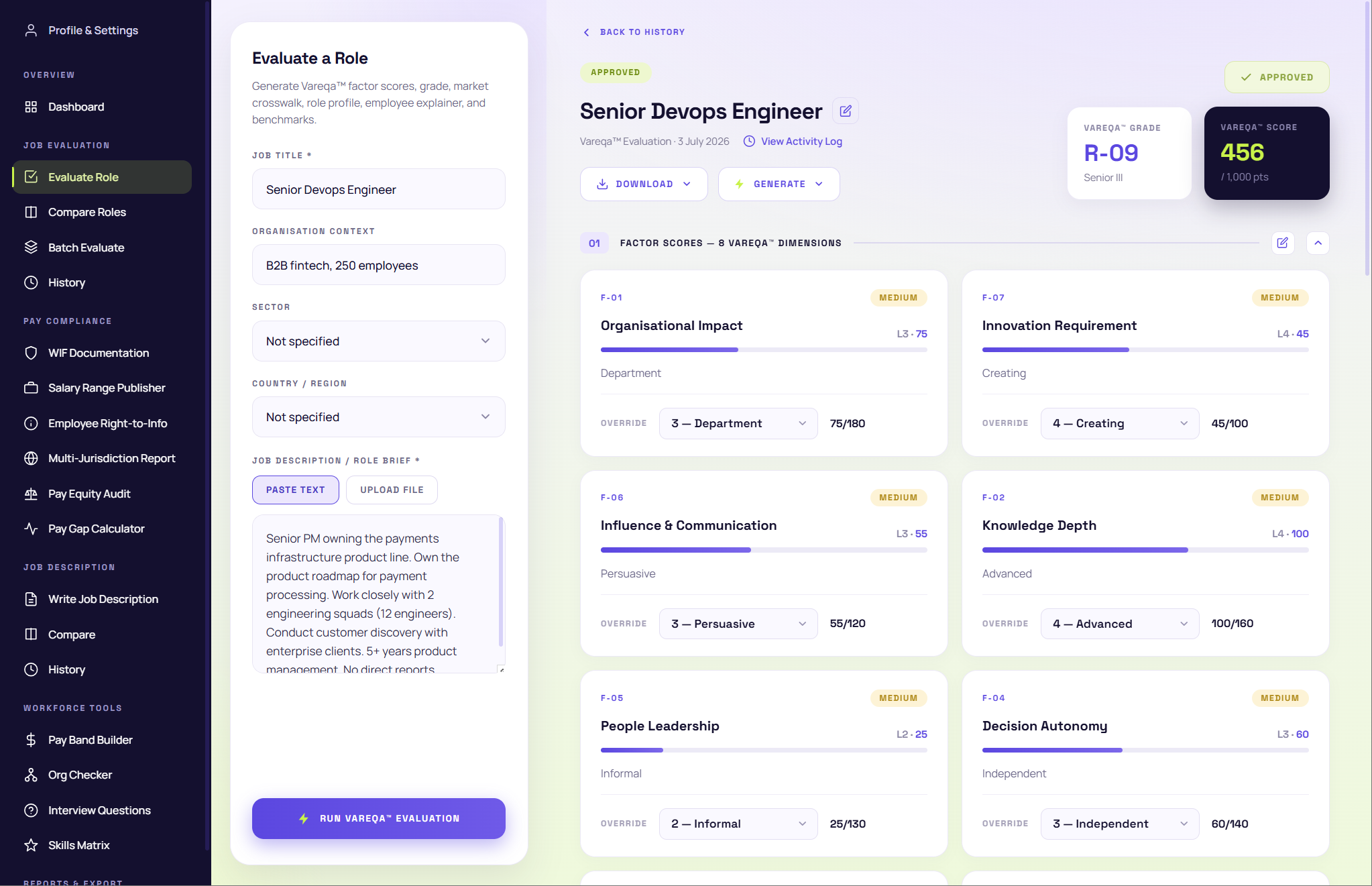
Every role is scored out of 1,000 points across the eight factors, and that score places it on a 20-grade ladder from R-01 to R-20. The structure is fixed and open. Where each grade begins and ends is calibrated to your organisation in your workspace.
The Role Evaluation Framework™ (REF™)
The full weighting is on the table: 1,000 points across eight factors, with nothing hidden. F-07 is the key departure, scored independently rather than folded into problem solving. Select any factor to see its share of the total.
Why these weightings
A weighting is only as good as the reasoning behind it. Here is the reasoning, in the open.
The eight factors map directly to the four criteria the law treats as objective and gender-neutral: skills, effort, responsibility, and working conditions, set out in Article 4(4) of the EU Pay Transparency Directive. Every factor sits under one of them, so the structure answers to the regulation in the regulation's own terms.
The weightings reflect established point-factor practice, tuned for the knowledge economy. Cognitive scope, accountability, and the capacity to innovate carry the most weight, because that is where value is created in most modern roles. Physical and risk conditions sit at 2 percent, present so the framework can grade every role type, not only desk-based ones. The same weights apply to every role.
A scheme is only gender-neutral if it can be shown to be. The same weightings are applied uniformly, and the framework is built to be tested for disparate impact against real workforce data, the standard the European Court of Justice set in Rummler v Dato-Druck: where one criterion favours characteristics more common in one sex, the scheme as a whole must give fair weight to characteristics more common in the other. That is a test you run on your own population, not a claim you take on trust.
The full weighting is on this page. A fuller methodology paper, setting out the evaluation literature behind each factor, is available in your workspace and on request, so a reviewer can examine the basis for the framework, not only its output.
Shown, not hidden
A method an employee can see and a regulator can follow keeps the burden of proof where you can meet it. So the structure is open to everyone. The calibration we tune to your organisation stays in your workspace, where it is yours to use and no one else's to copy.
Why it holds up
Every score carries its factor definitions, its points and a written rationale. You can hand the full derivation to an employee, an auditor or a regulator, and it reads the same to all three.
No factor relies on a proxy for sex, and the same eight factors are applied to every role. You can test the results for disparate impact on your own workforce, rather than taking neutrality on trust.
Scores are anchored to fixed factor definitions and published point values, not to a model's judgement on the day. Every evaluation is versioned and logged, so any decision can be traced back to the moment it was made.
The model proposes a score and a rationale. Your team reviews, adjusts and signs off. Every grade has a human owner, which is what a tribunal or a works council expects to see.
Get Started
A 30-minute conversation. We will walk you through the framework, where it fits, and how it stands behind the way you pay.